COUNCIL
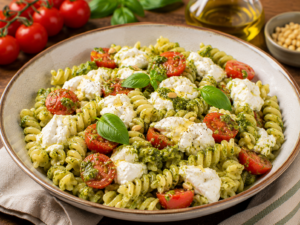
Il freshly prepared pesto It normally has a bright green color that, after a few minutes, can become darker and take on shades of olive green or brown. This change does not necessarily mean that the pesto has deteriorated: it depends mainly on theoxidation of basil.
With a few simple tricks, it is possible to slow down this process and maintain a fresh and inviting color for longer, without excessively altering the flavor of the preparation.
Why does basil turn dark?
When basil leaves are cut, crushed, or blended, their cells are damaged. Some compounds within the leaf come into contact with oxygen in the air and initiate a series of reactions that can cause the progressive deterioration of the plant. darkening.
The phenomenon is similar to what is observed when apples, pears or other vegetables are cut.
The more basil is processed and exposed to air, the more easily the color change becomes visible.
Heat can accelerate color change
One of the aspects to check when preparing pesto is the temperature.
High-speed blenders and mixers can heat ingredients, especially when used continuously for several seconds. Heat can promote browning reactions and, at the same time, alter some of the basil's more delicate aromas.
For this reason, when using a mixer, it is preferable to work with short pulses, frequently interrupting the processing.
Ingredients can also be kept cool before use. Keeping basil, the container, and other cold components cool helps limit temperature rise during preparation.
Dry the basil very well
Basil can be washed gently with fresh water, but before making the pesto it must be dried thoroughly.
The leaves can be placed on a clean tea towel or gently dried with kitchen paper.
The water left on the leaves does not help preserve the color and can make the pesto more liquid, also diluting its flavor.
It is also important to avoid crushing the basil unnecessarily during washing and drying.
Use cold ingredients
A simple system is to keep the ingredients fresh before preparation.
Basil can be stored in a cool place and also pine nuts, cheese and blender container they can be cooled for some time.
It is not necessary to freeze all the ingredients: in normal home preparation it is especially important to avoid the mixture from heating too much while being worked.
Processing must be done quickly, however. Continuing to blend a pesto that's already fairly smooth unnecessarily increases contact with air and temperature.
The oil helps protect the pesto from the air
The extra virgin olive oil It also performs an important physical function.
When it coats the basil particles, it reduces their direct contact with oxygen. For this reason, it's important to incorporate it properly during preparation.
The same principle can be used when storing pesto.
After transferring it into a container, the surface can be leveled and covered with a thin layer of oil, trying to leave as little air as possible between the pesto and the lid.
It is better to use a small container
If you only need to store a few spoonfuls of pesto, using a very large container leaves a significant amount of air inside.
It is therefore preferable to choose a container proportionate to the quantity of pesto, filling it almost completely.
The container must be closed well and quickly transferred to the refrigerator.
Each time you remove a portion of the pesto, the surface can be leveled again and protected with a little oil.
Does lemon really keep pesto green?
Lemon juice can slow down some reactions responsible for browning thanks to its acidity.
However, the taste of the preparation also changes.
In traditional Genoese pesto Lemon is not expected and a perceptible amount can introduce a tart note that is foreign to the original flavor profile.
It can be used in variations where acidity is desired, but it is not essential to make a good pesto.
Is blanching basil helpful?
Immersing basil briefly in boiling water and cooling it immediately can further stabilize its color.
This system, however, has a disadvantage: the heat modifies some of the fresh and delicate aromas characteristic of raw basil.
For this reason, the technique can be interesting when the visual aspect is particularly important, but it is not necessarily the best choice when you want to preserve the typical aroma of a freshly prepared pesto.
Mortar or blender?
The traditional mortar It allows you to work the ingredients gradually and without the rapid increase in temperature produced by the blades of a mixer.
The blender remains a practical solution. For best results, it's best to pulse it, using fresh ingredients, and avoiding unnecessary processing.
In both cases, it is important to prepare the pesto close to the time of consumption or to store it correctly immediately.
In conclusion
Pesto turns dark mainly because the basil, after being crushed or blended, comes into greater contact with oxygen.
To limit the phenomenon it is useful Work the basil quickly, avoid heating it, use fresh ingredients and reduce contact with air.
When storing, a well-filled container and a thin layer of oil on the surface further help protect the pesto.
A slight change in color remains a natural phenomenon and should not automatically be considered a sign of poor preparation.