COUNCIL
Le eggplant They are among the most versatile vegetables in the kitchen. They can be grilled, baked, sautéed, or fried, and used to prepare parmigiana, side dishes, pasta dishes, and numerous traditional Mediterranean recipes.
However, when cooked with oil, they exhibit a very noticeable characteristic: they seem to behave like a sponge. Simply toss a few cubes or slices into the pan and the oil on the bottom is quickly absorbed.
The result can be an excessively greasy and heavy dish. However, by better understanding the structure of the eggplant and using a few simple tricks, it is possible. limit oil absorption, obtaining a well-browned surface and a soft pulp.
Why do eggplants absorb so much oil?
The pulp of the aubergine has a particularly firm structure. porous and full of small spaces filled with air and water.
When cut and brought into contact with grease, the oil can easily distribute itself within this structure.
During cooking, some of the vegetable's water evaporates. The internal structure gradually changes, creating spaces into which oil can penetrate.
This phenomenon doesn't just happen while the eggplant is in the pan or fryer. Some of the oil on the surface can also be absorbed immediately after cooking, as the food begins to cool.
For this reason, the way aubergines are prepared, cooked and drained can significantly influence the final result.
Salt can be useful before cooking
One traditional method involves cutting the aubergines, sprinkling them with a little salt and letting them rest before cooking them.
The salt draws out some of the water present in the tissues and progressively modifies the structure of the pulp.
This treatment can make eggplants more compact and help reduce their tendency to absorb large amounts of oil during certain preparations.
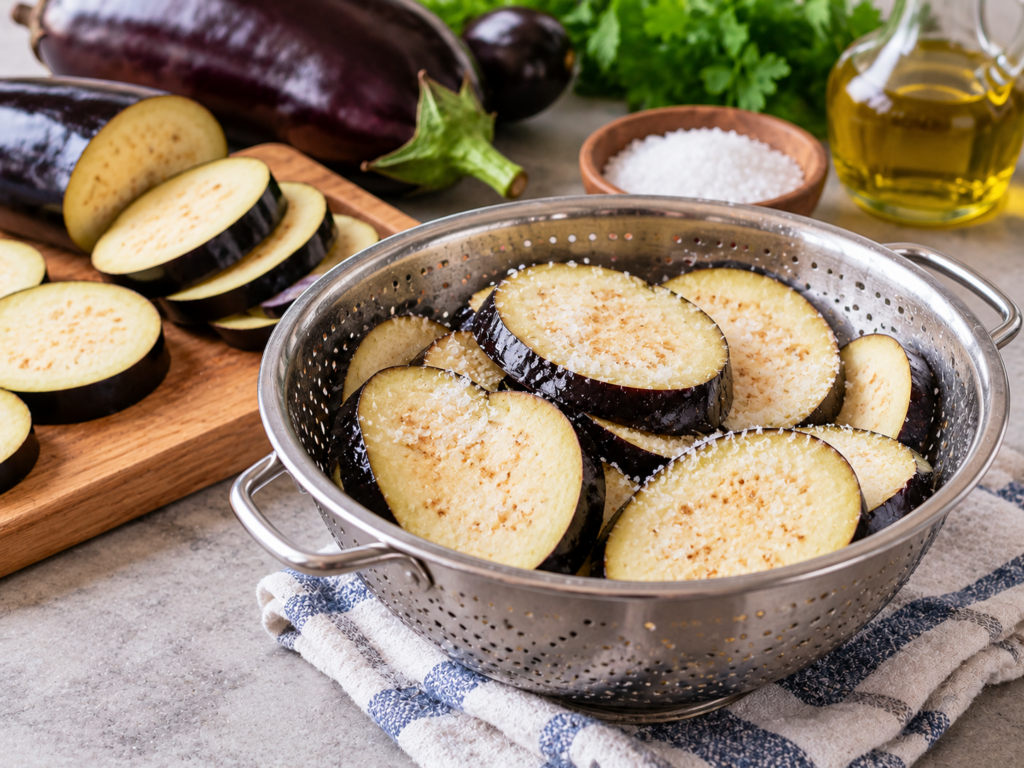
To use it, the aubergines can be cut into slices or cubes, placed in a colander and lightly salted.
After the rest it is important to eliminate the liquid present on the surface and above all dry the aubergines thoroughly before putting them in the oil.
They must not be wet when fried.
Does salting eggplant still remove bitterness?
Traditionally, aubergines were left in salt, mainly to reduce their bitter taste.
However, many commonly available modern varieties are naturally quite delicate and often do not require this treatment purely for reasons of taste.
Salting can, however, be useful for modifying the consistency of the pulp and its behavior during cooking.
It is therefore not a mandatory step for all recipes, but it can become interesting when you want to better control the oil absorption.
Drying them well is essential
Whatever treatment is used, before frying it is important that the surface of the aubergines is very dry.
This is especially true after rinsing or salt treatment.
Surface water, coming into contact with hot oil, quickly produces steam and can cause splashes.
Additionally, a dry surface facilitates more even browning.
The slices can be gently patted dry with kitchen paper or a clean tea towel before cooking.
The oil temperature must remain high enough
A common mistake is to put the aubergines in the oil before it has reached the right temperature.
For normal frying you generally work with very hot oil, often in the range of about 170-180 ° C, however adapting temperature and time to the size of the pieces and the type of preparation.
If the temperature drops too low, cooking slows down and it becomes more difficult to quickly achieve a well-cooked surface.
However, it's not necessary to heat the oil too high. Too much heat can darken the surface before the inside is ready.
The goal is to maintain a sufficiently stable temperature throughout the cooking process.
Don't put too many aubergines at once
Even when the oil has reached the correct temperature, adding a large amount of eggplant at once causes rapid cooling.
It is therefore preferable fry a few slices or a few cubes at a time.
Proceeding in several batches allows the oil temperature to recover quickly and promotes more even cooking.
The same principle applies when sautéing eggplant.
An overfilled pan retains steam more and makes browning difficult. When cooking a large quantity, it's best to divide it into two or more batches.
Avoid continuously adding more oil
When cooking aubergines in a pan, the oil may disappear almost immediately.
The most spontaneous reaction is to add more.
The aubergines also absorb this new quantity and a cycle easily starts in which you continue to pour oil until the end of cooking.
It's best to start with one controlled quantity, spreading it well on the bottom of the pan and letting the aubergines begin to cook.
With heat, their structure changes, the pulp softens and some of the fat can once again distribute itself on the surface.
Continuously adding oil is therefore not always necessary.
Spread the oil directly on the aubergines
For some baked or pan-fried dishes, it can be helpful to apply a measured amount of oil directly to the surface.
A kitchen brush allows, for example, to create a thin and uniform veil on the slices.
Alternatively, you can place the cubes in a bowl, add a set amount of oil and mix thoroughly before cooking.
This way, the seasoning is distributed throughout the pieces without having to keep adding fat during preparation. This method is especially useful for baked eggplant.
Pre-cooking can reduce the amount of oil needed
Another system consists of partially soften the aubergines before browning.
A brief pre-cooking in the microwave or oven changes the structure of the pulp and reduces the time needed for the subsequent pan-frying stage.
The pan is therefore used mainly to complete cooking and develop color and flavor.
This method is useful when you want soft, golden aubergines without resorting to actual frying.
It is important not to cook them completely during the first phase, otherwise they could fall apart during the subsequent browning.
The cut influences the result
Even the size and shape of the pieces can change their behavior during cooking.
Cutting the eggplant into very small pieces means increasing the total surface area exposed to oil.
Slightly larger cubes or regular slices may be easier to handle.
The most important thing is to keep the pieces similar in size, so that all the pieces reach the correct cooking level at the same time.
Very thin slices cook quickly, while thick pieces require more time for the heat to reach the center.
What happens during frying?
When an eggplant enters hot oil, the water contained in the outer layers quickly begins to turn into steam.
During this phase, heat, water and fat transfers occur simultaneously.
The surface changes structure and, as cooking progresses, small spaces form into which the oil can subsequently penetrate.
Fat absorption is therefore a more complex phenomenon than the simple image of the eggplant acting like a sponge.
Temperature, cooking time, pulp structure, piece size, and previous handling can all affect the outcome.
Drain the fried aubergines immediately
When the aubergines have reached the desired colour, it is important to remove them from the oil and let them drain immediately.
A significant portion of the fat initially remains on the surface.
During cooling, some of this oil can penetrate into spaces in the structure of the food.
Therefore, leaving the aubergines immersed in oil longer than necessary or piling them up in a container full of fat at the bottom is not a good solution.
It is best to use a slotted spoon, let the aubergines drain briefly over the pan, and immediately transfer them to paper towels or a rack.
Paper towels or grill?
Both systems can be used.
La kitchen paper It quickly absorbs some of the oil on the surface and is particularly practical for small quantities.
A grill instead allows excess fat to drain downwards without leaving the food in contact with the already soaked part of the paper for long.
For large quantities of fried aubergines, it may be helpful to place a rack over a baking tray.
However, it is important to avoid immediately placing too many layers of freshly fried aubergines on top.
Do you really need a lot of oil for pan-fried eggplant?
Not necessarily.
For normal pan-frying, you can obtain soft, golden aubergines using a moderate amount of fat.
The pan must be large enough and hot enough and the pieces must not be crowded together.
After an initial browning phase, if the pulp is not yet tender enough, you can lower the heat slightly and finish cooking.
However, you shouldn't expect the same result as an aubergine immersed in oil: Pan-frying and frying produce different consistencies.
Oven and air fryer are useful alternatives
When the main goal is to limit the amount of oil used, the oven and air fryer allow you to obtain interesting results.
The aubergines can be cut, lightly seasoned with oil and distributed without overlapping them.
The movement of hot air and the exposed surface promote water evaporation and browning.
Technically, it's not the same process as deep-frying, and the result has different characteristics, but it can be used for side dishes, fillings, pasta dishes, and numerous recipes where it's not essential to obtain a real fried aubergine.
So what is the best method?
There is no one-size-fits-all system for every recipe.
If you have to prepare fried aubergines for a parmigiana or for a traditional recipe, it can be useful to combine salting, careful drying, oil at the correct temperature, cooking in small quantities and immediate draining.
For everyday pan-fried cooking, however, it may be easier to control the amount of oil beforehand and avoid continually adding it during cooking.
When the amount of fat needs to be particularly limited, the oven, microwave for pre-cooking or air fryer can offer additional options.
In conclusion
Eggplants absorb oil easily, especially because of their porous internal structure, which changes further during cooking.
To limit its absorption, it is useful to intervene at various stages of preparation: treat the aubergines with salt if necessary, dry them thoroughly, maintain a stable oil temperature, cook a few at a time and quickly remove the surface fat after frying.
When cooking them in a pan, it is also important to avoid continuously adding new oil just because the initial one seems to have been completely absorbed.
With a few tricks, you can obtain soft, golden-brown aubergines, preserving their flavour without turning them into a dish overly soaked in oil.