COUNCIL
prepare the homemade mayonnaise It requires few ingredients, but during preparation it can happen that the sauce suddenly becomes liquid, grainy or begins to separate. In these cases it is commonly said that mayonnaise is “gone crazy”.
This problem doesn't necessarily mean the preparation should be thrown away. In most cases, the emulsion can be recovered with a few simple steps, gradually returning the oil and water to a creamy, smooth consistency.
Why does mayonnaise go curd?
Mayonnaise is aemulsion, that is, a preparation in which tiny drops of oil are distributed within an aqueous component.
Normally oil and water tend to separate, but the egg yolk It contains emulsifying substances, including lecithin, which help keep the fat droplets dispersed.
When the oil is incorporated correctly, the sauce becomes progressively thicker and more stable. However, if the oil drops start to fuse together, the emulsion loses stability and the mixture separates.
The result can be a very runny sauce, with visible oily areas or with an irregular consistency.
Adding too much oil quickly is one of the most common mistakes
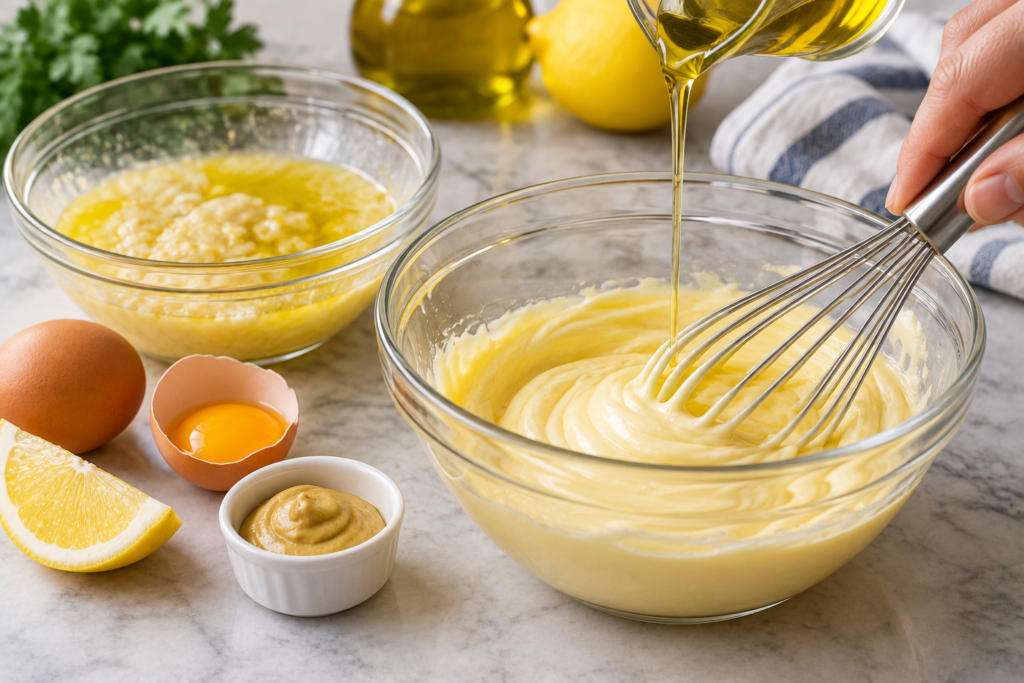
During traditional preparation with the whisk, especially at the beginning, the oil must be added very gradually.
Pouring too much before the first part has been properly incorporated can make it difficult to form an emulsion.
Once the mayonnaise has reached a good consistency, you can slightly increase the flow of oil, while continuing to stir.
If during preparation you notice that the sauce is suddenly becoming more liquid, it is better stop adding oil immediately and try to re-establish the emulsion before continuing.
The new yolk method
One of the most reliable systems for recovering a completely separated mayonnaise is to create a new emulsion.
Place the egg yolk in a clean bowl and whisk briefly. You can also add a few drops of lemon juice or a small amount of mustard.
At this point the set mayonnaise should not be poured all at once.
It is added initially very little compound, continuing to whisk vigorously. When the new emulsion begins to become creamy, gradually incorporate the remaining separated mayonnaise.
In this way, the previous preparation is practically used as if it were the oil for a new mayonnaise.
It's important to proceed slowly, especially in the first few steps. Once the sauce appears stable and creamy, the amount added can be gradually increased.
Can it be recovered without adding another egg?
In some cases, yes.
When the emulsion is only slightly destabilized, it may be sufficient to place it in a clean bowl a teaspoon of water or a few drops of lemon juice and gradually add a small amount of the separated mayonnaise, whisking continuously.
When the mixture becomes creamy again, gradually add the rest.
Even a small amount of mustard It can help because it contains substances that promote the stabilization of the emulsion.
This method is especially useful when the mayonnaise has just started to separate and you don't want to add more egg yolk.
What to do if the mayonnaise is simply too runny?
A thin mayonnaise doesn't necessarily mean it's gone bad.
If the sauce appears smooth but remains too runny, the emulsion may have formed correctly without yet reaching the desired consistency.
In this case, it is important not to intervene immediately by adding large quantities of ingredients.
You can continue to work the preparation and add the oil little by little, gradually checking the consistency.
If, however, separated oil and a watery portion are clearly visible, continuing to add grease will unlikely solve the problem: it is preferable to stop and restart the emulsion using one of the recovery methods.
Pay attention to the temperature of the ingredients
To facilitate preparation it is useful for the ingredients to have a similar temperature.
Using a very cold egg with warmer ingredients can make the emulsion less easy to control.
For this reason, in traditional preparation, it is often preferable to use ingredients at room temperature.
However, it is not necessary to heat them: the main goal is to avoid very marked temperature differences.
How to prevent mayonnaise from curdling
Prevention is easier than recovery.
When using a hand or electric whisk, it is best to start by adding the oil in drops or with a very thin thread, waiting for it to be incorporated before pouring more.
You need to keep mixing without stopping, especially in the initial phase.
The container can also help. A bowl that's not too wide allows the whisk to work a small amount of product effectively and facilitates the initial formation of the emulsion.
When the mayonnaise begins to become thick and shiny, it means that the structure is forming correctly.
And with the immersion blender?
The immersion blender allows you to prepare mayonnaise using a different technique.
Generally the ingredients are placed in a tall, narrow glass, with the watery part and the egg on the bottom and the oil on top.
The blender is placed on the bottom and turned on without moving it immediately. When a thick, light cream begins to form at the bottom, the blender can be slowly lifted to gradually incorporate the remaining oil.
Moving the blender too soon can prevent the first emulsion from forming properly.
Again, if the sauce separates, it can be recovered by preparing a new base and slowly incorporating the mixture.
Don't keep blending without control
When something goes wrong, the most natural reaction is to keep blending, hoping that the sauce will suddenly become creamy again.
It doesn't always work.
If the emulsion is now clearly separated, continuing to work it without changing the ratio of the ingredients may simply temporarily distribute the oil without recreating a stable structure.
It is better to stop, transfer the preparation and use a new emulsifying base.
Does recovered mayonnaise taste different?
If recovered correctly, the difference can be minimal.
Adding a new egg yolk can make the sauce slightly richer and thicker. If necessary, you can balance the flavor with a little salt, lemon juice, or vinegar at the end.
It is preferable to make these corrections only after re-establishing the emulsion, avoiding changing too many elements at once while trying to recover the sauce.
In conclusion
A crazy mayonnaise it doesn't necessarily have to be thrown away.
Separation occurs when the emulsion between the aqueous part and the oil loses stability, often because the oil was added too quickly or because it was not dispersed properly during preparation.
The safest system is to start from a new yolk and very slowly incorporate the separated mayonnaise, creating a new emulsion. In less severe cases, it may be sufficient to start with a little water, lemon juice, or mustard and gradually add the sauce.
Proceeding slowly, monitoring the amount of oil and stopping as soon as the first signs of separation appear almost always allows you to avoid waste and restore the mayonnaise to a smooth and creamy consistency.