COUNCIL
La raw onion It's an ingredient capable of adding character to salads, sandwiches, bruschetta, sauces, and numerous summer dishes. Its crunchy texture and intense aroma, however, can become overwhelming, especially when using particularly pungent varieties.
In these cases, it's not necessary to give up the onion or cook it. Simply rinsing it in water can be done. to tone down its more aggressive flavor, retaining much of the freshness and consistency that make it interesting in raw preparations.
Why is raw onion so pungent?
When an onion is cut, its cells break and some substances that normally remain separate come into contact.
From these reactions different compounds are formed sulfur-containing compounds, responsible for much of the onion's characteristic aroma and the pungent sensation perceived when eaten raw.
The finer the onion is cut, the larger the surface area exposed and the more quickly these substances can spread.
This is why a very finely chopped onion may seem more intense than the same amount cut into larger wedges or slices.
The simplest method: soaking in water
One of the most practical ways to make raw onion more delicate is to leave it in cold water for a few minutes.
After peeling it, the onion can be cut into the shape required for the preparation: rings, half rings, small cubes or thin strips.
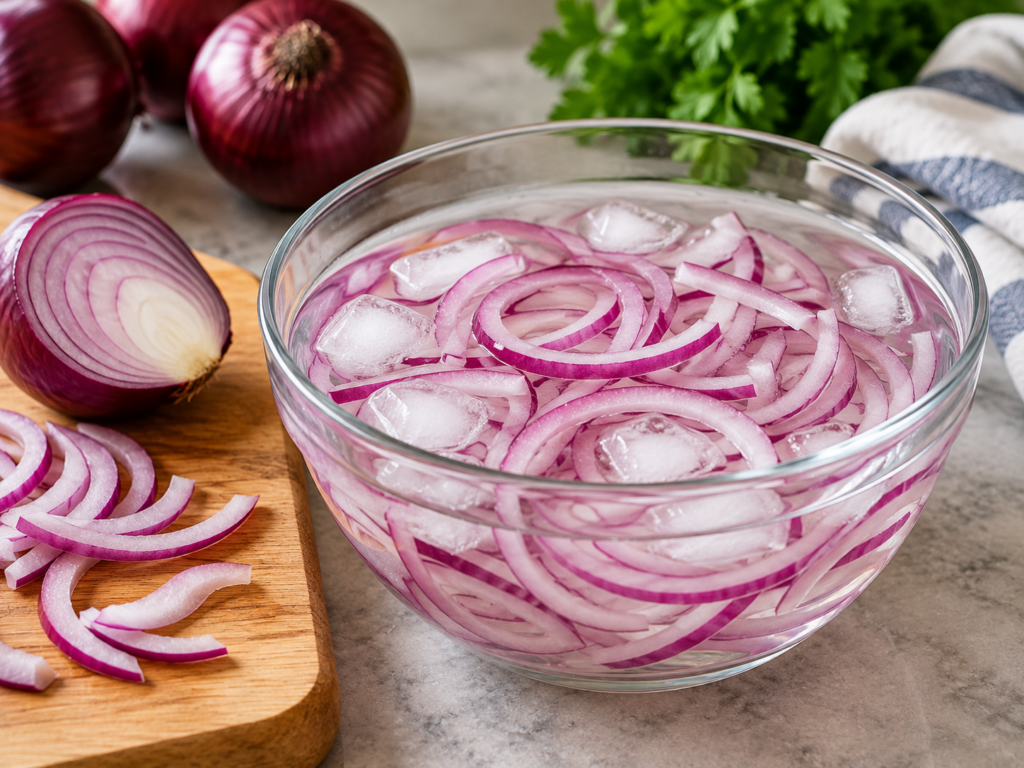
The pieces are then transferred to a bowl and completely covered with cold water.
A soak of about 10 15-minute It is generally sufficient to tone down some of the onion's pungent intensity without overly altering its character.
If the onion is particularly strong, the time can be slightly extended.
Why does water work?
When the cut onion is immersed in water, some of the substances present on the cut surfaces are dispersed into the liquid.
In this way the taste can gradually become softer and less aggressive, while the pulp maintains its crunchy consistency.
The effect isn't to completely eliminate the onion's flavor. The goal is to reduce its most pungent part, while still leaving the ingredient recognizable.
Precisely for this reason, the method is particularly suitable when the onion must accompany other flavours without dominating them.
Cold water or water and ice?
For a particularly crunchy result you can use very cold water or water with a few ice cubes.
The low temperature helps keep the onion's structure compact during soaking.
This system can be especially useful with very thinly sliced onions intended for salads, burgers, sandwiches and cold dishes.
However, it's not essential to use ice. In most cases, a regular bowl of cold water will suffice.
It is important to drain the onion well
Once soaked, the onion must be drained thoroughly.
If it is to be used in a salad or in a preparation in which water could dilute the dressing, it is also advisabledry it gently with kitchen paper or a clean tea towel.
This step is especially important when using oil, sauces, or creamy dressings.
An onion that is still very wet can in fact make it more difficult to distribute the seasoning evenly and add unwanted water to the dish.
Does this method also work with red onion?
Yes. The red onions It is probably one of the varieties in which this measure finds greatest application.
It is often used raw for its bright color and crunchy texture, but some onions can have a rather intense flavor.
Finely chop it and leave it briefly in water to make it more delicate without having to cook it.
The method can also be used with white and yellow onions when you want to add them raw to a preparation.
The result, however, depends on the variety and the individual onion: some are naturally sweeter, while others have a much more evident pungency.
Lemon and vinegar produce a different result
An often used alternative is to leave the chopped onion in contact with lemon juice or vinegar.
These ingredients can make onions enjoyable to eat raw, but the result isn't quite the same as soaking them in plain water.
The acid introduces its own flavor and initiates a light marinade. The onion then takes on a tart note that can be very pleasant, but it must be compatible with the dish.
For a Mediterranean salad, a sauce, or a fish dish, acidity can be an advantage. However, if you want to keep the onion's flavor as neutral as possible, it's best to use just water.
There is no need to leave the onion to soak for hours
To tone down the pungent intensity, it is not necessary to prepare the onion many hours in advance.
A relatively short soaking already allows for a perceptible change.
Leaving it in the water for much longer than necessary can instead make the flavour progressively less distinctive.
It's therefore helpful to taste a small piece after a few minutes. Once the onion has reached the desired intensity, it can be drained immediately.
This way, it is possible to adapt the treatment both to the variety used and to personal taste.
When is it best to use this method?
Soaking is especially useful when the onion is consumed completely raw and it should not represent the main flavour of the preparation.
It can be used, for example, for onions intended for salads, bruschetta, sandwiches, burgers, wraps, poke, fresh sauces and cold dishes.
It is also useful when a recipe calls for a considerable amount of onion and you want to prevent its aroma from overpowering the other ingredients.
If the onion needs to be cooked, however, this step is usually unnecessary. Heat naturally alters many of the compounds responsible for the pungent flavor, gradually developing softer, sweeter aromas.
Chop the onion before soaking
To obtain a visible effect it is preferable first cut the onion and then immerse it in water.
Soaking a whole or peeled onion would have very little effect, as the liquid would only come into contact with the outer surface.
When cut, however, numerous surfaces are exposed from which some of the substances responsible for the intense flavour can disperse into the water.
The thickness also influences the result: very thin washers are treated more quickly than large pieces.
A sharp knife also helps in this case
Using well-sharpened knife It allows you to obtain regular cuts and crush the pulp less.
A dull blade, on the other hand, tends to compress the onion more and break a greater quantity of cells during cutting.
In addition to making the work more precise, a good knife allows you to handle the ingredient more cleanly.
To obtain particularly thin slices, you can also use a mandolin, always paying close attention to protecting your fingers.
Choose a naturally delicate onion
Soaking can tone down the pungent intensity, but the choice of raw materials remains important.
If a preparation requires large quantities of raw onion, it may be convenient to start with a naturally sweet or slightly pungent variety.
However, the characteristics vary according to the variety, cultivation and storage period, so two apparently similar onions may have different intensities.
Tasting a small piece before using it allows you to immediately understand if soaking is necessary.
A little trick that can change a dish
In some preparations, the difference between a pleasantly aromatic onion and one that is too aggressive can be notable.
Simply soaking them in water allows you to better control their intensity without eliminating their crunchiness.
It is particularly useful when the onion needs to complement the dish together with other delicate ingredients, such as tomatoes, fresh cheeses, vegetables, fish or light sauces.
By adjusting the soaking time you can also choose how much to tone down its character.
In conclusion
To make raw onion is less pungent simply cut it and leave it in cold water for about 10-15 minutes, then drain and dry it thoroughly.
During soaking, some of the substances responsible for the more aggressive flavor disperse into the water, while the onion retains a fresh and crunchy consistency.
Water and ice can be used when you want to keep it particularly crunchy, while lemon and vinegar are suitable alternatives when you also want to add a tart note.
It's a simple trick, especially useful for salads, sandwiches, and cold dishes, which allows the onion to complement the other ingredients without overpowering their flavor.